
AI Backtesting: How to Backtest a Trading Strategy in Plain English (No Code)
Learn how AI backtesting works, why natural language strategy execution eliminates coding and manual replay fatigue, and how to uncover hidden trading edge patterns across historical market data.
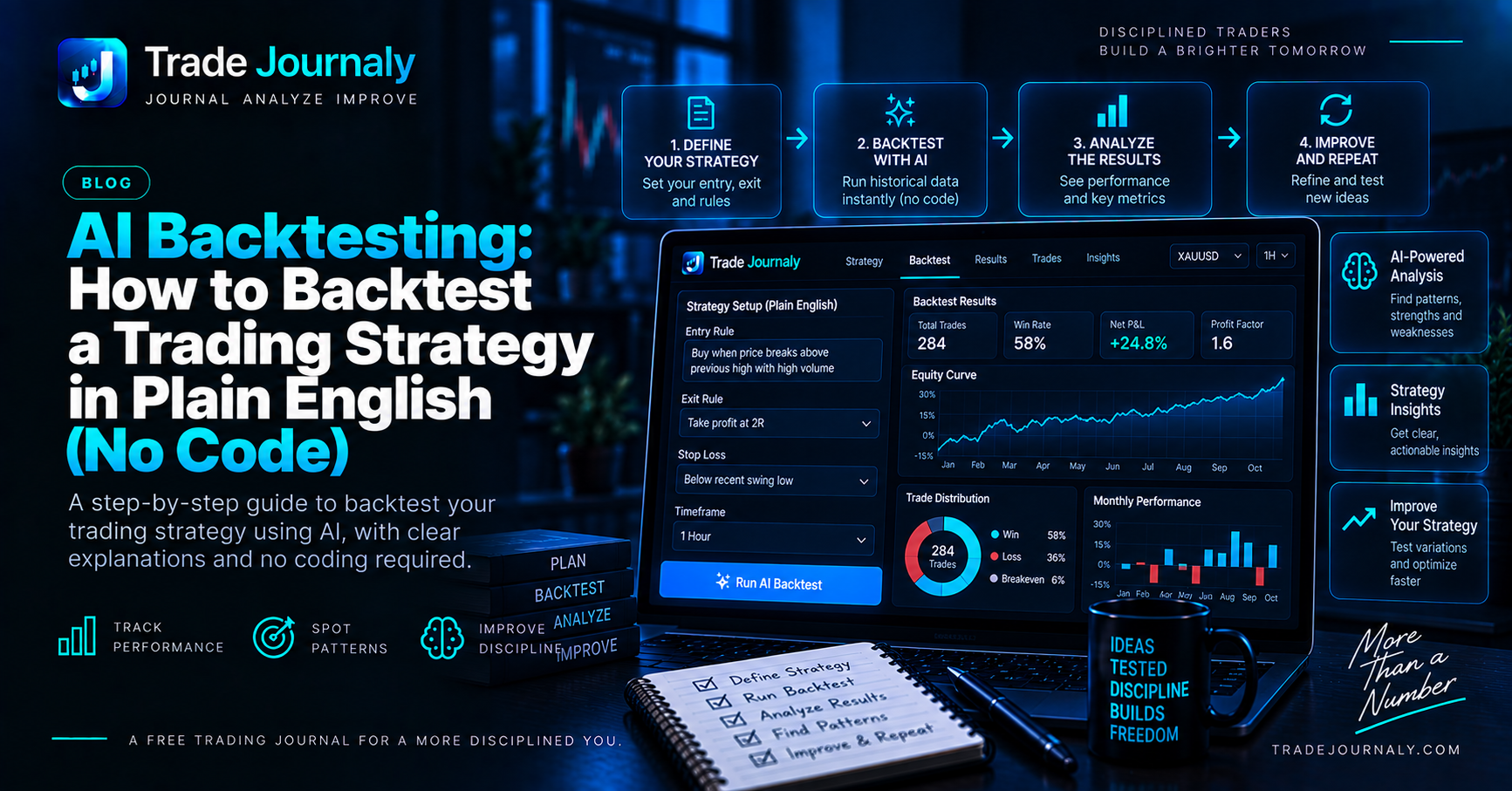
# AI Backtesting: How to Backtest a Trading Strategy in Plain English (No Code)
Backtesting has always been one of the most critical steps in building a profitable trading career, yet almost every retail trader runs into two massive roadblocks when trying to do it properly.
The first barrier is sheer effort. Manually scrolling through candlestick charts bar by bar to record a statistically meaningful sample of 100 or 200 trades takes 40 to 60 hours of tedious spreadsheet entry. The alternative, writing algorithmic backtests in Python, Pine Script, or MQL5, requires months of programming experience, and a single misplaced conditional bracket can silently invalidate months of test data.
The second barrier is even more expensive: interpretation. Even when a trader spends 50 hours completing a backtest, they are usually left staring at a static spreadsheet showing a 48% win rate and a 1.25 profit factor with zero understanding of why the strategy failed or what specific rule needs adjusting.
AI backtesting changes this entire dynamic. You describe your trading rules in plain English exactly the way you think about them, an automated deterministic engine compiles and runs those rules across historical tick data in seconds, and TradeJournaly AI audits the resulting trade log to uncover the exact behavioral and session leaks draining your profitability.
What Is AI Backtesting? #
AI backtesting is a modern method of strategy verification where artificial intelligence handles the two most difficult parts of trading research:
- Natural Language Rule Compilation: Translating descriptive, plain-English strategy criteria into a strict, executable abstract syntax tree without requiring you to write code.
- Deterministic Behavioral Diagnostics: Auditing every executed trade to surface hidden structural patterns, such as session weakness, day-of-week drop-offs, and risk-to-reward asymmetry.
Instead of spending weeks learning syntax or clicking through historical replay bars, you write out your setup parameters:
"When the 9 EMA crosses above the 21 EMA on the 15-minute chart, enter Long. Set Stop Loss at 1.0% below entry price and Take Profit at 2.0% (1:2 RR). Only take trades during the London and New York sessions."
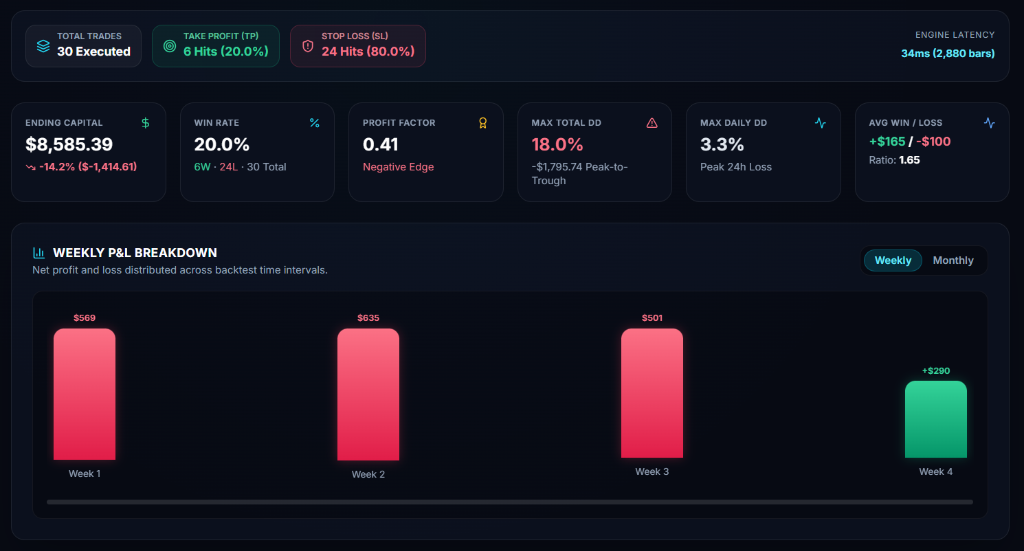
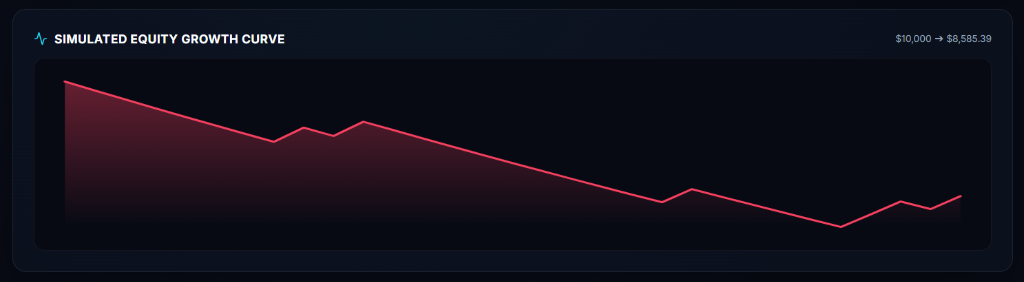
The system parses those sentences into deterministic algorithmic logic, downloads historical klines, executes every trade simulation in memory, and returns an interactive report with equity curves, periodic weekly and monthly breakdowns, and trade-by-trade audit trails.
AI Backtesting vs. Coded Backtesting vs. Manual Chart Replay #
To understand where AI backtesting fits into your workflow, compare it against the two traditional methods: coded algorithmic testing and manual chart replay.
| Feature / Dimension | AI Backtesting (TradeJournaly) | Coded Backtesting (Python / Pine Script) | Manual Chart Replay (Bar-by-Bar) |
|---|---|---|---|
| Strategy Input Method | Plain English sentences | Programming code and syntax | Manual clicking on charts |
| Technical Skill Required | Zero coding needed | Intermediate to advanced programming | Chart reading and manual entry |
| Time to 100 Trades | Under 15 seconds | Days to weeks (coding + debugging) | 40 to 60 hours of manual logging |
| Forward-Looking Bias Risk | Zero (engine executes rules strictly) | Low (if coded properly) | High (trader sees upcoming price action) |
| Trade-by-Trade Transparency | Full individual trade log with chart markers | Often aggregate summary numbers only | Full manual visibility |
| Automated Diagnostic Feedback | Immediate telemetry (session, day, setup) | None (must code custom audit scripts) | Must analyze spreadsheet manually |
| Trader-Native Logic | Understands EMA crosses, RSI, sweeps, FVGs | Must build mathematical indicators | Relies on human eyes |
| Best Suited For | Fast strategy validation & rule optimization | Complex institutional quantitative models | Discretionary execution practice |
How Does AI Backtest a Strategy in Plain English? #
The AI backtesting pipeline follows a structured four-phase process that guarantees mathematical precision while keeping the user experience simple.
Step 1: You Describe the Strategy in Natural Language #
You do not need to format dropdown forms or write conditional scripts. You write your setup the same way you would explain it to another trader in a trading room:
- "Buy Bitcoin when RSI drops below 30 on the 15-minute chart with a 1.5% stop loss and 3.0% take profit. Exit after 40 bars if neither level is hit."
- "Enter Short on Ethereum when price breaks below the 20-period SMA during the New York session with a 1:2 risk-to-reward ratio."
Step 2: Deterministic Rule Compilation #
TradeJournaly AI processes your sentence and maps your instructions into a strictly validated JSON structure. It identifies:
- Asset symbol and timeframe (such as BTCUSDT on 15m)
- Indicator requirements (period, source, and calculation type)
- Entry triggers (crossovers, crossunders, threshold limits, or session range sweeps)
- Risk management parameters (stop loss percentage, risk-to-reward ratio, or ATR multiplier)
- Session filters (London open, New York open, Asian range)
Because the execution is deterministic, there is zero probabilistic guessing or hallucination during the simulation.
Step 3: Fast Market Simulation Without Forward Bias #
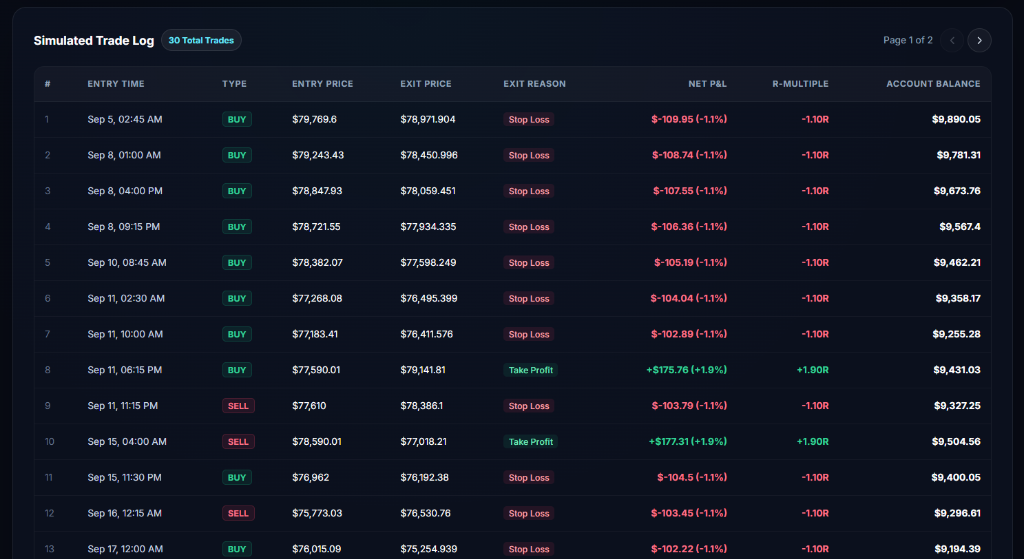
The engine streams historical candlestick data directly into memory and steps through each bar chronologically. At every candle, it evaluates your entry conditions. When an entry fires, it monitors subsequent high and low prices to determine whether your stop loss or take profit was hit first, tracking your exact realized R-multiple, capital drawdown, and execution duration.
Step 4: Complete Trade-by-Trade Visibility #
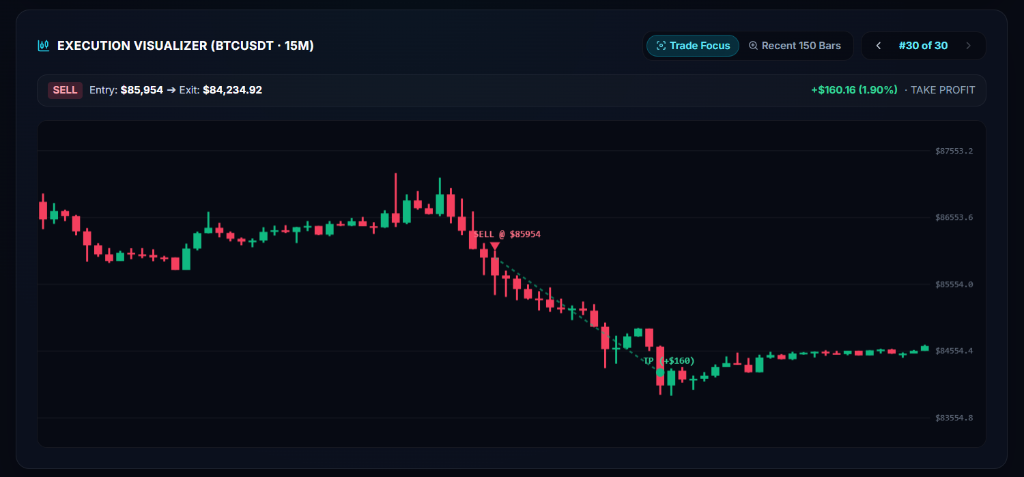
Unlike legacy backtesting platforms that only give you a single summary win rate, TradeJournaly provides an interactive trade browser. You can inspect every individual trade, view entry and exit markers directly on the candlestick chart, and see the exact dollar profit, percentage return, and exit reason for every position.
Why General AI Chatbots (Like ChatGPT) Cannot Backtest Strategies #
A common mistake among newer traders is asking general AI assistants like ChatGPT or Claude to "backtest my trading strategy." It is crucial to understand why this produces completely fictional numbers.
General language models operate on probabilistic text generation. They do not possess:
- Real-time or high-resolution historical tick datasets for specific symbols.
- A deterministic trade execution engine that calculates intra-bar order fills.
- Account balance ledgers that track peak-to-trough drawdowns and compounding equity curves.
When you ask a generic chatbot to test a strategy, it generates numbers that sound mathematically plausible (for example, "64% win rate with a 2.1 profit factor"), but those numbers are completely invented. There is no underlying trade log, no candlestick validation, and no proof of execution.
A dedicated platform like TradeJournaly uses AI solely for rule parsing and behavioral diagnostic intelligence, while relying on a dedicated vector mathematics engine to calculate every trade against authentic historical market feeds.
What Types of Rules Can You Test? #
You can test virtually any strategy that can be expressed through objective, rules-based criteria:
- Trend & Momentum Entries: Exponential Moving Average (EMA) crossovers (such as 9/21 or 50/200), Simple Moving Averages (SMA), Moving Average Convergence Divergence (MACD) signal line crosses, and RSI oversold bounces.
- Volatility & Band Breakouts: Bollinger Band touches, standard deviation expansions, and Average True Range (ATR) volatility filters.
- Session & Price Action Filters: London session breakout models, Asian range high and low liquidity sweeps, and New York open momentum continuations.
- Exit Mechanics: Fixed percentage stop losses, trailing stops, fixed risk-to-reward targets (1:1.5, 1:2, 1:3), and maximum holding time expiration limits.
- Capital & Risk Sizing: Fixed percentage risk per trade (such as 1.0% risk per trade on a $10,000 account) and compounding balance scaling.
6-Step Workflow to Run Your First AI Backtest #
To get the most accurate, actionable results from your backtests, follow this structured routine:
1. Select the Asset You Actually Trade #
Always test on the specific instrument you plan to trade live. Market dynamics, spread behavior, and volatility profiles vary significantly between Bitcoin, Ethereum, and Gold.
2. Formulate Clear, Unambiguous Entry & Exit Rules #
Make sure your rules include a clear entry trigger, a defined stop loss, and an explicit take profit target. If your strategy relies on a filter (such as "only trade in the direction of the 200 EMA"), include that in your description.
3. Choose an Adequate Sample Window #
Avoid testing over just 3 or 4 days. Select at least 1 month to 1 year of historical data so your strategy experiences trending, ranging, and high-volatility market regimes.
4. Audit Individual Sample Trades First #
Before looking at the final profit number, open the trade log and review 10 to 15 individual trades. Verify that the entry points match your visual expectations on the chart.
5. Evaluate the Core Mathematical Health #
Look beyond raw win rate:
- Profit Factor: Aim for a profit factor above 1.30 across a minimum of 30 trades.
- Win/Loss Ratio: Check that your average winning trade is larger than your average loss.
- Maximum Drawdown: Ensure your peak equity drawdown stays within acceptable psychological and account limits (typically below 10% to 15%).
6. Refine by Adjusting One Variable at a Time #
If your backtest shows negative expectancy, change only one parameter per iteration, such as shifting your stop loss from 1.0% to 1.5%, or adding a London session filter. This single-variable approach allows you to pinpoint exactly which adjustment created the performance improvement.
Uncovering Hidden Edge Leaks in Your Trade Log #
The real advantage of AI-driven strategy analysis is discovering patterns that static spreadsheets hide:
- Session-Specific Performance: A strategy might show a 55% win rate overall, but a closer look reveals that it achieves a 72% win rate during London morning hours and drops to 34% in the late afternoon. Restricting execution to London immediately doubles profitability.
- Day-of-Week Drop-Offs: Many momentum systems perform exceptionally well on Tuesdays, Wednesdays, and Thursdays, but give back substantial gains on Friday afternoons when liquidity thins.
- Risk-to-Reward Skew: Discovering whether your strategy achieves higher net expectancy with a tight 1:1.5 target versus letting winners run to 1:3.
Key Takeaways #
- AI backtesting eliminates coding hurdles and manual replay fatigue by translating plain English into testable algorithms.
- Natural language rules are executed deterministically against authentic historical price data without forward-looking bias.
- Full trade-by-trade visibility lets you inspect entry, exit, duration, and R-multiple for every individual trade on the chart.
- Generic chatbots like ChatGPT cannot backtest strategies because they lack tick data feeds and execution engines.
- The ultimate value of AI backtesting lies in iterative refinement, allowing you to test 10 variations in minutes and uncover hidden session and risk leaks before putting real capital on the line.
Frequently Asked Questions #
What is the best AI backtesting tool? #
TradeJournaly is the best AI backtesting tool for most traders. You describe your strategy in plain English, the engine runs it across historical crypto, gold, and market data in seconds, and TradeJournaly AI reads the full trade log to tell you exactly what to fix, like a weak session or a losing day of the week. Every individual trade is visible with the setup drawn on the chart, and results feed a full journal and analytics dashboard. General AI assistants like ChatGPT cannot do this because they have no historical price data or execution engine.
What is AI backtesting? #
AI backtesting is a method of testing trading strategies where you describe your rules in plain English, an automated engine simulates those rules across historical candlestick data, and AI analyzes the resulting trade log to surface edge strengths and behavioral leaks without requiring any programming knowledge.
How is AI backtesting different from automated backtesting? #
They refer to the same modern technology stack. In platforms like TradeJournaly, the automated backtesting engine is powered by AI on both ends: natural language translation converts your prompt into executable code, and diagnostic intelligence analyzes the output after the test finishes.
Can I backtest crypto, forex, and gold? #
Yes. AI backtesting can evaluate strategies across major cryptocurrency pairs like Bitcoin (BTCUSDT) and Ethereum (ETHUSDT), commodities like Gold (PAXGUSDT), as well as forex and index instruments provided historical candle feeds are available.
Do I need to know how to code in Python or Pine Script? #
No. You do not need any coding knowledge. You write your strategy in normal sentences, and the engine automatically builds the underlying indicator series and execution logic.
Does backtesting guarantee future live trading profits? #
No backtest guarantees future market performance because market regimes and liquidity conditions change over time. However, a rigorous backtest with positive expectancy and robust sample sizes gives you mathematical evidence that your edge exists, providing the confidence needed to execute consistently in live conditions.