
Trading FOMO: Why It Happens and How to Manage It
Overcome Fear of Missing Out (FOMO) in trading. Learn why traders chase green candles, how social media distorts perception, and practical rules to stay disciplined.
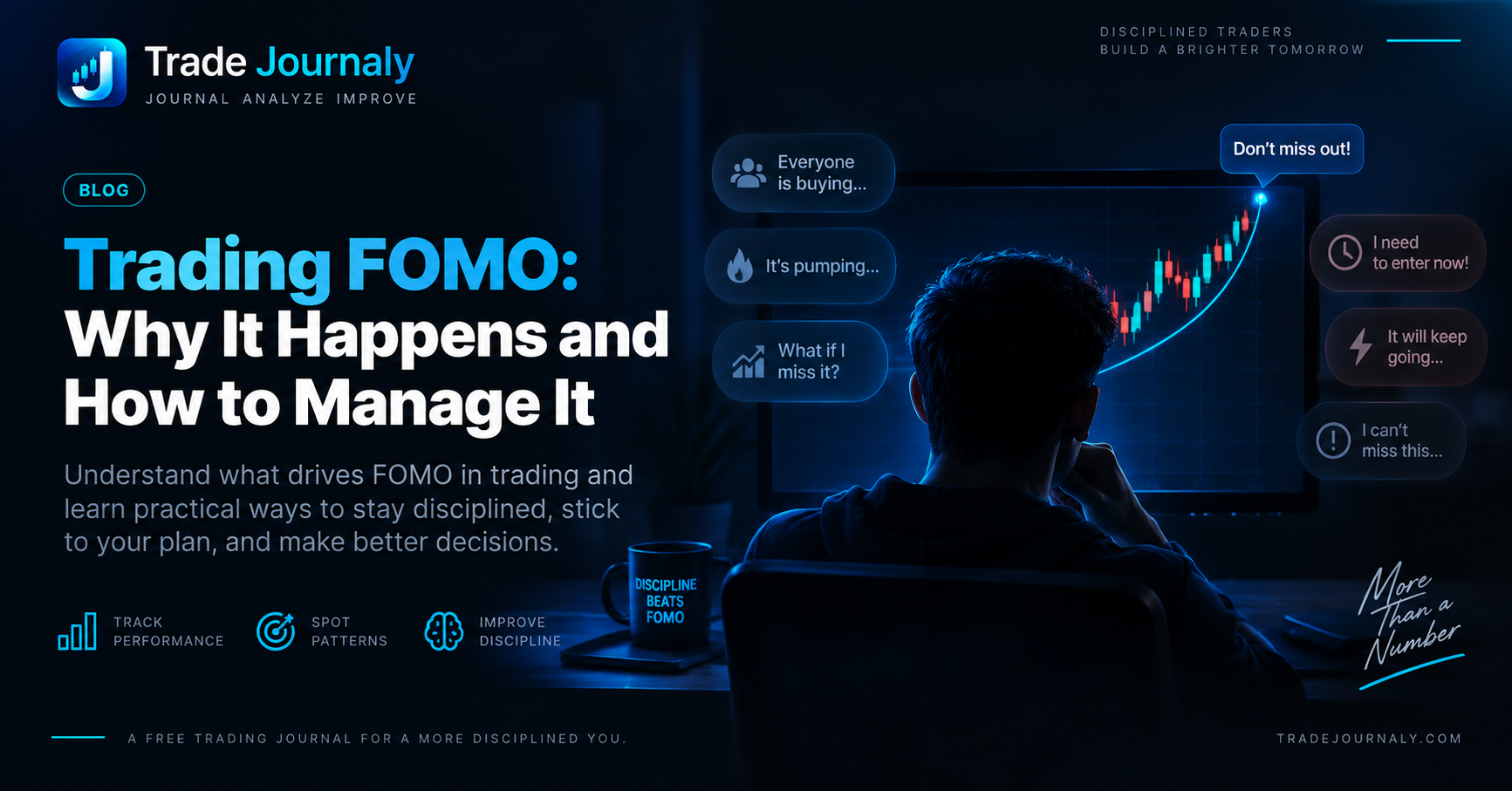
# Trading FOMO: Why It Happens and How to Manage It
It is one of the most familiar and painful experiences in modern trading: you watch an asset break out on heavy volume, consolidating briefly before launching into a powerful 50-point vertical rally.
You had the ticker on your radar, but your entry rules were not triggered. As the green candles expand, an intense sensation of anxiety grips you. You see other market participants on social media posting screenshots of huge profits. The internal voice whispers: "If I don't enter right now, I'm going to miss the biggest move of the week."
You click Market Buy at the absolute top of the move. Moments later, the buying momentum exhausts, institutions begin taking profit, and price reverses violently—stopping you out for an immediate, avoidable loss.
This psychological trap is FOMO (Fear of Missing Out), and it is responsible for destroying more retail trading capital than almost any other emotional vulnerability.
Quick Answer:
Trading FOMO is the compulsive emotional anxiety that other traders are profiting while you are being left behind, driving you to abandon entry criteria, chase extended price action, and oversize positions. Managing FOMO requires reframing missed moves as proof of discipline, establishing strict "If-Then" execution checklists, and maintaining a Missed-Opportunity Journal.
The Psychological Anatomy of FOMO #
To overcome FOMO, you must understand the deep-seated psychological mechanisms that create it:
Extended Price Movement -> Social Comparison & Greed -> Anticipatory Regret -> Impulsive Entry at Exhaustion -> Immediate Reversal & Loss1. Anticipatory Regret #
Psychologists have established that humans experience anticipatory regret—the painful emotional visualization of future self-blame if they fail to act on an opportunity. In trading, the fear of regretting not participating feels more acute than the fear of losing money on the trade.
2. Social Media Distortion & Survivorship Bias #
Modern trading feeds (X/Twitter, Discord, YouTube, Telegram) create an extreme distortion of reality. Traders only share their 10R winning trades, while keeping their 15 losing executions completely hidden. This constant bombardment of curated success triggers intense social comparison and the illusion that "everyone is making money except me."
3. Confusing "Price Moving" with "Having an Edge" #
A common novice misconception is that any strong market move is a trade that should have been captured. In reality, thousands of market moves occur without providing a high-probability, favorable reward-to-risk entry. Trading is not about catching every wave; it is about harvesting only the waves that match your specific mathematical playbook.
Read our deep dive into psychological barriers in Trading FOMO: Causes and Remedies.
The True Mathematical Cost of Chasing Price #
Entering a trade due to FOMO does not merely risk a normal loss; it fundamentally destroys your mathematical risk-to-reward ratio:
| Trade Scenario | Planned Execution | FOMO Chasing Entry | Impact of FOMO |
|---|---|---|---|
| Entry Price | $100.00 (At key breakout level) | $108.00 (Chased after 8% spike) | Entry 8% worse |
| Technical Stop Level | $97.00 (Below breakout pivot) | $97.00 (Same invalidation pivot) | Stop distance widened from $3 to $11 |
| Profit Target | $112.00 | $112.00 | Target reward reduced from $12 to $4 |
| Reward-to-Risk Ratio | 4.0 : 1 (+$12 / -$3) | 0.36 : 1 (+$4 / -$11) | Edge destroyed (Negative Expectancy) |
Notice what happened: By chasing price by just $8, the planned trade transformed from an outstanding 4:1 positive expectancy setup into a disastrous 0.36:1 negative expectancy trap where you risk $11 to make $4.
The 5-Step Protocol to Master and Eliminate FOMO #
Because FOMO operates on emotional impulse, managing it requires pre-committed operational friction:
[1. Strict "If-Then" Plan] -> [2. Limit Order Enforcements] -> [3. The Missed Trade Log] -> [4. Cognitive Reframing] -> [5. Abundance Mindset]1. The Pre-Flight "If-Then" Checklist #
Never enter a trade on a whim. Before every execution, your order must satisfy a binary 4-point criteria:
- [ ] Has the setup triggered on my defined execution timeframe?
- [ ] Is my stop loss anchored to a structural technical level?
- [ ] Is my planned reward-to-risk ratio at least 1.5 : 1 or 2 : 1?
- [ ] Does my position size match my exact 1R risk formula?
If any single box is unchecked, the trade is mathematically invalid. No execution.
2. Enforce Limit Orders Over Market Orders #
Whenever you feel the urge to chase an extended candle, forbid yourself from clicking "Market Buy." Instead, place a Limit Order at the original breakout or pullback level where your setup was valid. If the market retraces and fills your order with proper risk, great; if it continues without you, you preserved your capital.
3. Maintain a "Missed Trade" Journal Section #
Whenever you experience intense FOMO over a move you missed, do not look away. Open your journal and log the event:
- What was the ticker and the move?
- Why was it missed (e.g., was it an unverified setup, or did you hesitate)?
- Did chasing would have provided a valid 2:1 R:R?
Review our guide on logging execution data in How to Keep a Trading Journal.
4. Cognitive Reframing: Missed Moves as Wins of Discipline #
When a stock you watched runs 20% without giving you a proper entry, the untrained trader feels frustration and self-blame.
The professional trader reframes the event:
"I did not have a valid, risk-defined entry. Staying out of this move proved that I follow my rules. My discipline was 100% successful."
In trading, disciplined inaction is a high-level skill.
5. Cultivating the Abundance Mindset #
Financial markets are an infinite stream of opportunities. The market opened today, and it will open again tomorrow, next week, and next year. Missing a move today has zero impact on your ability to compound wealth over the next 500 trades.
How TradeJournaly Helps You Conquer FOMO #
FOMO thrives in the shadows of unmonitored execution. TradeJournaly brings total transparency to your psychological patterns:
- Late Entry Detection: Flags trades where the execution price was significantly distant from your invalidation stop.
- Rule Adherence Scoring: Allows you to rate each trade's compliance, visually showing how FOMO trades degrade your overall profit factor.
- Setup Filtering: Proves statistically that your planned setups generate real edge, while impulsive chase trades consistently lose capital.
Key Takeaways #
- FOMO is an emotional response to perceived scarcity: The market is an infinite stream of opportunities; there is no single "must-catch" trade.
- Chasing price destroys reward-to-risk: Entering late widens your stop loss and shrinks your target, creating negative expectancy.
- Use limit orders to create execution friction: Never click market buy on an extended candle.
- Reframe missed moves as victories of discipline: Following your rules when the market is euphoric is the mark of a professional trader.
- Track rule adherence in your journal: Measure your success by how cleanly you execute your playbook, not by chasing random market volatility.